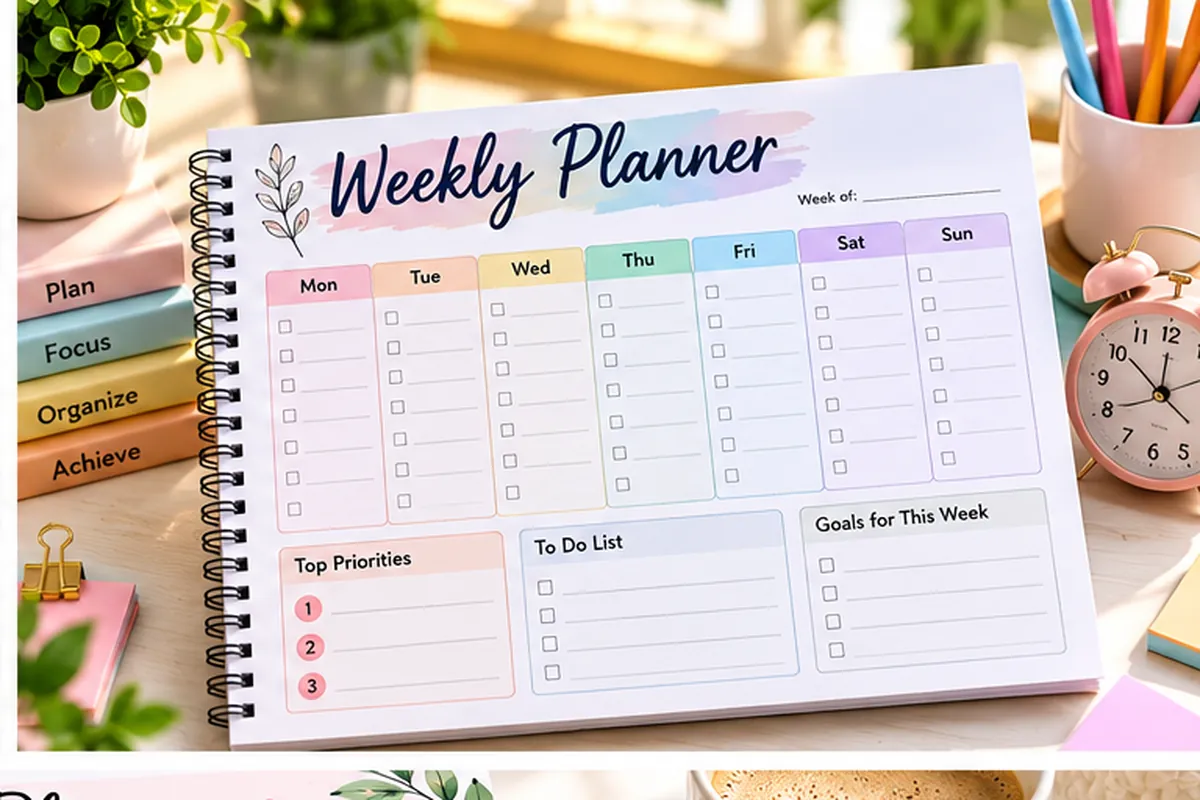
A weekly planner will provide you with a clear picture of what you have to deal with in the next seven days. With tasks, appointments, goals, and reminders in one place, you can keep them out of your head. This is an easy trick that can help a hectic week to run more smoothly.
Some weeks involve no stress and then become stressful in a day or two. Tasks come up, appointments change, errands get in the way, little tasks vie for your attention. If you don’t have a plan, you might waste more time than you need considering what you should do.
Here’s where a weekly planner will come in handy. This week planner printable organizes your priorities, goals, tasks, habits, appointments, notes and weekly reflection all in one place. Print it out, fill it in by hand and store it in a place where you can access it all week.
Let’s find out what a weekly planner is!

A weekly planner is a planning sheet that can help you plan your week. A weekly planner provides a view of multiple days, unlike a daily planner might do.
The broader perspective allows for easier planning as it helps to distribute the work over a week rather than attempting to complete it in a single week. Also, you can see that certain days are busy, and schedule less significant tasks to come on other days.
Specialty: The weekly planner templates come with different layouts. Some only have appointments, while others have goals, habits, priorities, notes or personal planning. Ideally a useful template will provide you with enough structure to keep you organized but not so much that you feel like you’re working a second job.
That’s the approach we use in our planner. It allows you to have a clear layout and other designated spaces to mark the important parts of your week.

When making a decision, begin with your top priorities.
On top of this weekly planner you will see a box for your 3 major priorities.
These should be the elements that are of the highest priority for focus this week. They are not required to have all of your tasks on their list. Rather, pick some of the things that made you feel like the week was a success.
You may have to complete an important work task, study for an exam, tidy your house or finish an important personal task.
If you just write down the 3 things that you are most interested in, you’ll have to prioritize. The problem with that is that long lists of tasks tend to conceal the important tasks. If you know your priorities, you can allow them to take up time before other minor tasks take over your time.
Identify (and document) clear weekly goals.
This planner has space beside the priority section for weekly goals.
Priorities and goals can appear very much the same thing in theory, yet they can be for various things in practice. A priority indicates what is important. A goal is something you wish to achieve.
For instance, the phrase “work on my website” is in the general sense. Once you have two new planner pages, you have a better direction to go.
Try to keep your weekly goals realistic. A planner should be for making a week “manageable” and not “full”.
Little things can make a big difference. Several pages a day, a walk every day, cooking in the kitchen, or completing a part of a project – these things would help you get somewhere without taking up too much time.
Make Mondays to Sundays in the plan.
The front of this weekly planner template offers a unique section for each day from Monday to Sunday.
Each day you can use it to list tasks, reminders, errands, study work, meetings, household work, or anything else that requires your attention.
Begin by tasks that have a set day. Schedule appointments, deadlines, meetings, classes or events first. Then, schedule flexible after that.
Don’t overstuffed every line simply because there is room. Allow for flexibility with work and/or schedule changes. A planner is not always a perfect week and a bit of room allows you to make adjustments later.
A small notes section is included in each day’s section as well. It could be to serve as reminders, numbers for the phone, thoughts or extra information that doesn’t quite fit into your task list.
This section provides you with a guide to using a weekly planner.
The best way to work with a weekly planner is to create it when you don’t have a lot of things going on. Many people schedule their Sunday evening but any time that works for your routine will do.
Start with the week or date at the top. Next, check on future appointments, deadlines, work, school events and personal obligations.
Decide which are your most important priorities and set your weekly goals before you do the daily parts. This will ensure that important work is still in sight while you are constructing the rest of your schedule.
Then, schedule activities to the daily list that you can realistically do. Leave ample time for challenging assignments and try to keep one day from being overloaded.
After the first day of the week, review your planner every day. Marking up tasks and moving unmarked work as required and small changes as the schedule evolves.
It doesn’t matter if you don’t stick to your planner precisely. Follow it as a blueprint for decision-making around how you spend your time.
Using a weekly planner to help you plan your day.
Your weekly plan provides you with an overview, but you need to put a little effort into it every morning.
Review tasks and prioritize which one to work on first for the day. In general, resolve one task first that impacts a deadline or one of your weekly priorities if possible.
Avoid starting the day with small jobs because they are easy. Small messages or small jobs can make you feel busy but not accomplish any meaningful work.
Another option is to check out the next day before you check in to your current one. This little check can save you time when going to appointments, collecting items and not getting surprised the next morning.
If you take this approach with the planner, your actions for the day will help you achieve your goals for the week.
Use the Habit Tracker to build better habits!

There’s also a habit tracker at the bottom of the page that you can use as a weekly planner.
A habit tracker will help you remember to log recurring activities during the entire week. It could be a habit you want to monitor like exercise, reading, water consumption, study time, early mornings, journal, or something else that is important to you.
Only select a handful of habits that you really want to work on. Having too many to track will be frustrating.
Mark the corresponding day if you’ve successfully done a habit. The marks over time become a visual proof of your consistency.
It’s not about getting things right straight away each week. The tracker will assist you to see patterns. If you are consistently missing a habit one or more days a week, you may try altering the time, lowering the habit, or selecting a more attainable routine.
Make Important Appointments Visible!
This planner allows for clear separation of appointments from a lengthy task lists.
Schedule meetings, medical appointments, school events, calls, deadlines, interviews or other appointments that require specific time in the Important Appointments area.
If they are separate, they’re easier to see when you review your planner.
It is still possible to write an appointment within the daily appointment section. Taking some big dates into this dedicated space, however, provides another quick reminder of events you don’t want to miss out on.
Include any additional information in the Notes Section – Extra Details
Not all thoughts should be scheduled.
The bigger notes section will provide you space for information you would like to have close at hand for the week. Write shopping reminders, project ideas, things to talk to someone about, meal ideas, follow up tasks or anything else you think you might need later.
This section also helps random notes to stay out of your prime task areas. This means the daily sections don’t get as hard to read.
Conclude the week with a Weekly Reflection
The planning shouldn’t stop on Sunday!
The Weekly Reflection section provides an opportunity for you to reflect on what you have learned from the past week before beginning this week. It prompts you to consider what worked, what needs work, and what you want to work on in the future.
This mini review can help you in planning future weeks.
Perhaps you’ve got a lot of your most critical tasks scheduled in the morning, and you finished them early. You may repeat the same process. You may have been moving the same task three times because your schedule was too full. That is a sign that you’ll need to schedule fewer tasks the next time.
Your planner is transformed with reflection. This assists in learning about your own habits and planning for more realistic.
So, what is the best use of a weekly planner?
A weekly planner is most effective when it enables you to see what is going on in your week.
Don’t use it as a list of all the things you have to do! Use it to determine what is important, when, and how each part of your week will fit.
The ideal planner should help to clear the mind. If a task is still on paper, you don’t have to constantly remind yourself of it throughout the day.
Some other benefit of a weekly plan is that you reserve time to yourself. As work, study and family activities and obligations begin to dominate the week, it is easy to notice. From there, you can find room for rest, exercise, hobbies, and people who are important to you.
So, why is a weekly planner printable important for you?
Printable weekly planner templates are great for those who like to hand-write or have a straightforward planner without any other application.
A new copy can be printed as needed. Completed pages may also be stored in a folder or binder for future reference to look back on previous weeks.
Printable planners provide flexibility, too. You can type fast, add notes, check off the desired items, highlight, and make it your personal format to work with!
They also eliminate a lot of the digital planning distractions. You can sit down with the page, be able to think about your week, and you’re only focused on planning.
Who is able to use the Weekly Planner Templates?
Weekly planner templates are effective for students, professionals, parents, business owners, freelancers, teachers and anyone with multiple responsibilities to manage during the week.
The planner could be used for class, homework, exams, and student goals. A freelancer might arrange their client’s work, deadlines, meetings, and own projects. One parent could be keeping track of appointments, errands, school activities, meals, and household activities.
The layout remains the same, but how you use it may change as you change your lifestyle.
When your schedule shifts from week to week, a weekly planner comes in handy.
Find activities to help manage Make Your Week.
There’s no need to use a complex productivity system to be organized. Sometimes, it can help to have a bit of paper and a few minutes of planning.
It provides you with the space for your priorities, weekly goals, daily tasks, notes, habits, appointments, and end-of-week reflection in this weekly planner. These sections will make it easy to figure out what is important without having a full plate.
Print and fill in the planner with tasks and commitments that are important, and place it somewhere easily accessible. Check it every day during the week and modify it if the plans change.
The key is to have a useful weekly plan that doesn’t put the pressure on your week. It should help you to spend less time wondering what to do next and more time doing what you want to do.