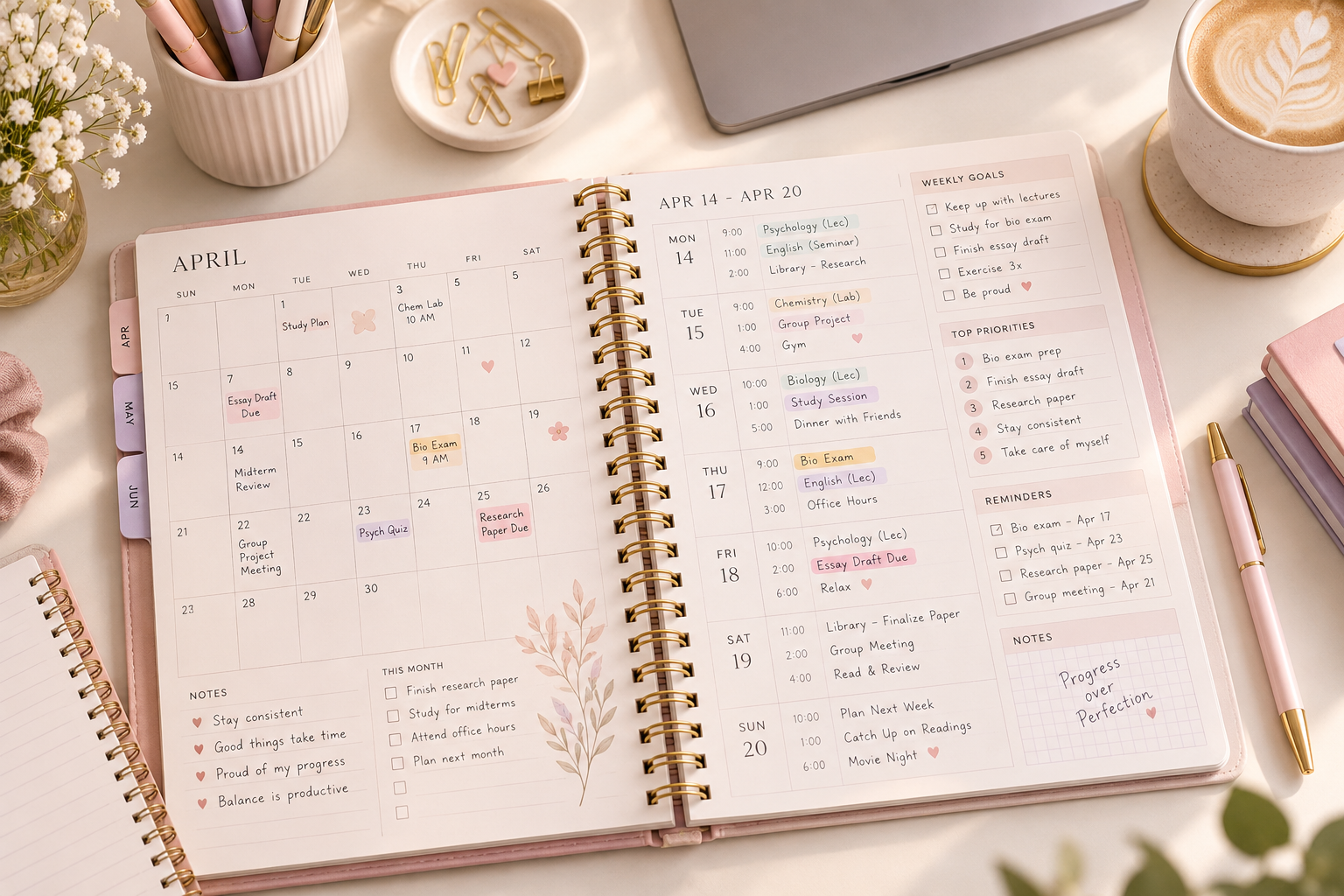
Academic planners help students organize classes, assignments, examinations, and academic goals throughout the school year. A well-organized planner can make academic responsibilities easier to manage, whether you are starting college, attending high school, or preparing for university exams.
Schoolwork can quickly feel overwhelming when deadlines approach, unexpected homework appears, and several assignments need attention at once. Many students struggle because they try to remember everything instead of keeping their responsibilities in one reliable place.
Fortunately, you don’t need an expensive digital tool or a complicated system to get organized. A simple academic planner can give you a clearer view of what needs to happen and when.
In this guide, you’ll learn how to choose an academic planner, build a practical 2026–2027 study schedule, keep track of assignments, and develop better planning habits. You’ll also find useful tables, real-life examples, and advice from respected universities.
What Is an Academic Planner?
An academic planner is an organizational tool that helps students manage schoolwork, class timetables, homework, exam dates, and educational goals.
Academic planners are different from ordinary calendars because they focus on learning activities and academic progress. A college student, for instance, can record lectures, coursework deadlines, study time, and examination dates in a college planner. Similarly, a high school student can use a weekly academic planner to keep track of homework, quizzes, and school events.
Academic planners come in several forms, including printable
Pdf s, notebooks, digital planners, and academic-year calendars. Your best option depends on your course requirements, the devices available to you, and how you prefer to plan.
Why Are Academic Planners Important for Student Success?
Effective student planning involves more than writing down homework. It helps you understand your responsibilities, see approaching deadlines, and make realistic decisions about the time you have available.
Better Time Management
Academic planners help you decide when to study, complete assignments, attend classes, and take breaks. Instead of asking yourself what to do next, you can open your planner and review your priorities.
Clear Assignment Tracking
A student planner gives each assignment a specific place. When you record the subject, deadline, and progress, you can identify unfinished work before it becomes urgent.
More Consistent Study Habits
Study planners encourage students to spread revision across several days instead of trying to learn everything at the last minute. Cornell University’s Learning Strategies Center explains that semester and weekly calendars can help students identify important deadlines and organize their study time.
Reference: Cornell University — Managing Time.
Better Balance Between Academic and Personal Life
Schoolwork matters, but so do rest, exercise, family responsibilities, and personal activities. A practical academic planner helps you make space for these commitments instead of overloading your schedule.
Types of Academic Planners: Which One Do You Need?
Different academic planners serve different purposes. Understanding each format can help you choose the right planner for students at your level.
| Planner type | Best for | Main purpose |
|---|---|---|
| Daily academic planner | Busy school or college days | Daily priorities and study sessions |
| Weekly academic planner | School and college students | Homework and weekly tasks |
| Monthly academic planner | Long-term organization | Exams, events, and deadlines |
| College planner | University students | Lectures, courses, and projects |
| Study planner | Exam preparation | Revision sessions and study goals |
| Academic-year planner | Full-year planning | Semester dates and school events |
| Assignment tracker | Coursework and projects | Deadlines and task progress |
You don’t need to use all these planners. For many students, a semester calendar, a weekly schedule, and a short daily checklist are enough to begin.
Academic Planner 2026–2027: How to Plan the School Year
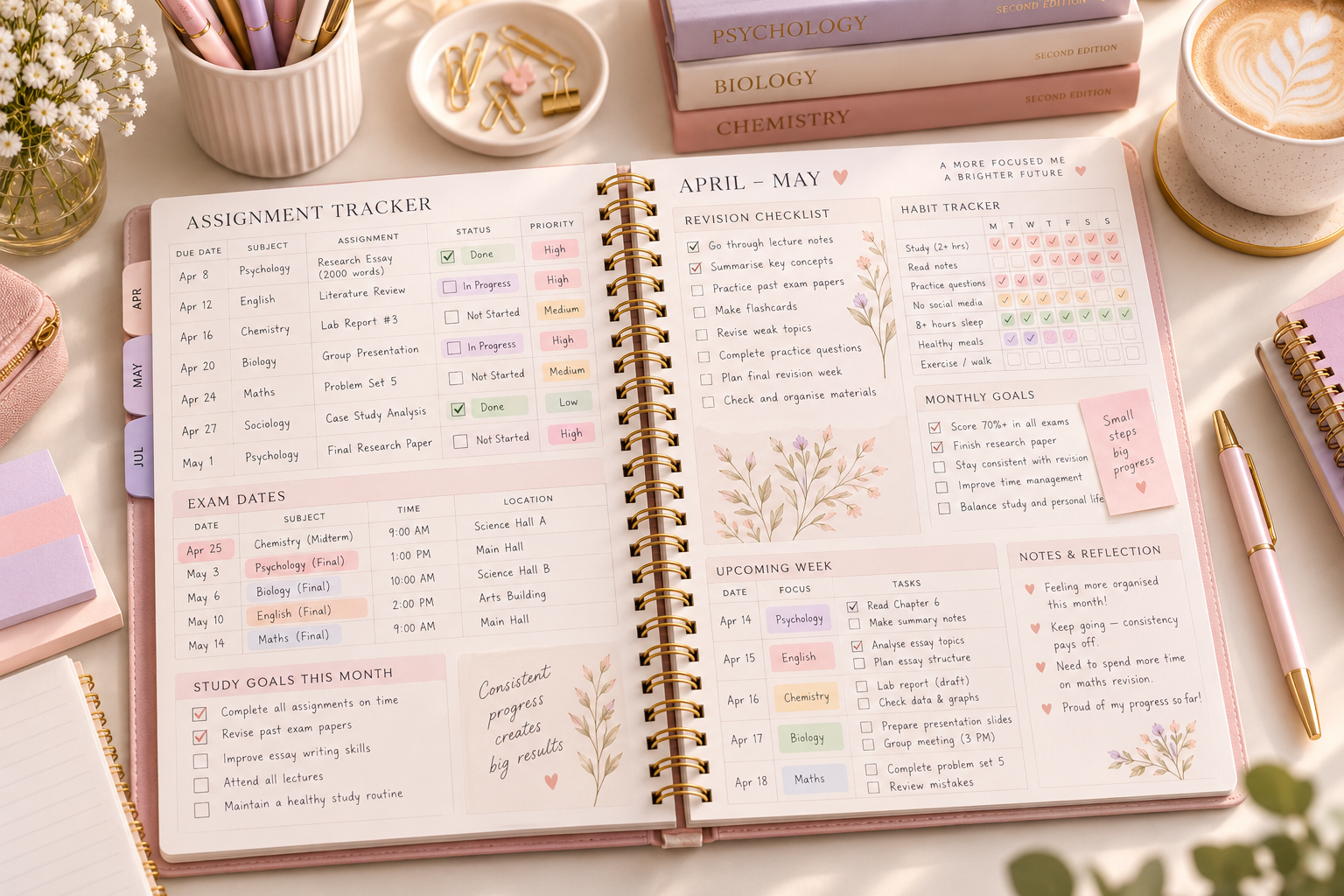
A 2026–2027 planner can help you organize educational activities that take place across the 2026 and 2027 calendar years. However, academic calendars differ between schools, universities, and countries. Some institutions use semesters; others follow terms, quarters, or different school schedules.
Before setting up an academic planner 2026 2027, collect your institution’s official calendar. Record the first and last days of each term, examination periods, assignment and project deadlines, holidays, presentations, and important registration dates.
Step 1: Create a Yearly Academic Overview
Begin with an annual or semester calendar. Write down major exams, coursework deadlines, university events, and important appointments as soon as their dates are confirmed. This helps you see which months may be especially busy and gives you more time to prepare.
Step 2: Organize Each Month
Move your important academic dates into a monthly planner. If several assignments are due in November, for example, you can spot the busy period early and start preparing in October.
Step 3: Plan Individual Weeks
Use a weekly planner to break large assignments into manageable tasks. If a research project takes four weeks, you might reserve separate weeks for research, outlining, drafting, and editing.
Step 4: Review Your Daily Schedule
Finally, choose realistic daily priorities that connect to your weekly and semester goals. A daily academic planner keeps the larger plan practical.
Students searching for an academic planner 26-27 or a 2026 to 2027 planner should check the dates covered by the template before choosing it. An academic-year planner and a January-to-December calendar-year planner may cover different periods.
How to Use Academic Planners: 9 Practical Tips
These nine tips can help you create a planning system that works for your school or college routine.
1. Start With Your School or College Calendar
Gather your course outlines, school calendar, and class timetables. Record exam dates, project deadlines, holidays, and other important events in one place.
Don’t rely on memory alone. An academic calendar provides an overview of the term so you can prepare for difficult weeks rather than react to them at the last minute.
2. Choose a Planner That Fits Your Routine
The best planner for students is one they can use regularly. If you enjoy handwriting, a printable academic planner may be convenient. If your schedule changes often, a digital planner may be easier to update.
Think about how much writing space you need, how often you add tasks, and whether a daily or weekly layout suits you better. Avoid choosing a complicated planner just because it looks attractive.
3. Record Homework and Assignment Deadlines
An assignment tracker is one of the most useful parts of academic planners. Whenever a teacher or lecturer announces a new task, note the assignment name, subject, deadline, and progress.
Here’s a simple example:
| Subject | Assignment | Deadline | Progress |
|---|---|---|---|
| Mathematics | Algebra worksheet | Monday | In progress |
| English | Research essay | Wednesday | Not started |
| Biology | Laboratory report | Friday | In progress |
| History | Chapter summary | Saturday | Completed |
Review the tracker each day so important assignments don’t slip through the cracks.
4. Create a Weekly Study Calendar
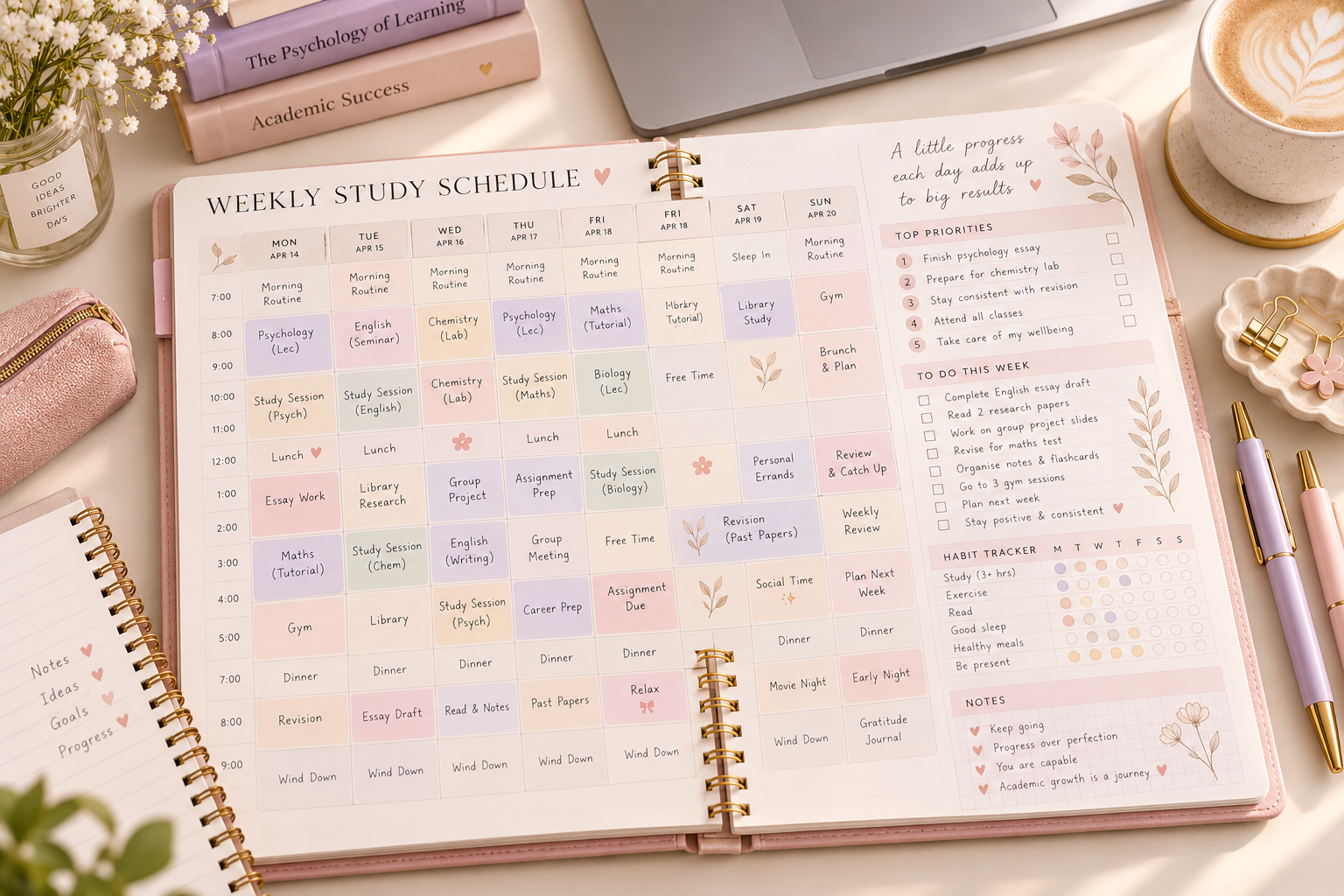
A study calendar helps you spread academic responsibilities across the week. First, add fixed commitments such as classes, lectures, appointments, and part-time work. Next, block out specific study periods. Finally, include time for meals, sleep, and personal activities.
The University of Sydney’s time-management guidance discusses planning by semester, week, and day to help students manage their workload and competing commitments.
Reference: University of Sydney — Time Management.
5. Break Large Projects Into Smaller Tasks
Major assignments can feel difficult when you think of them as one enormous task. Instead, divide the work into stages.
For a research essay, you might:
- Choose a research topic.
- Collect credible sources.
- Prepare an outline.
- Write the first draft.
- Edit and proofread your work.
- Review the references.
- Submit the finished assignment.
Set a realistic deadline for each stage. This makes progress easier to track and helps you identify problems before the final submission date.
6. Set Clear Academic Goals
Academic planners become more useful when you connect what you do each day with what you want to achieve.
Instead of writing “Improve mathematics,” try “Complete 15 mathematics practice questions three times this week.” Similarly, replace “Study biology” with “Review Chapter 4 and answer 10 practice questions.”
Clear goals make it easier to understand what progress looks like and what you should do next.
7. Plan Exam Revision in Advance
Study planners are especially helpful when examinations approach. Write down each exam date as soon as it is announced, then spread revision across manageable sessions.
Here’s an example of a five-day revision plan:
| Day | Study activity |
|---|---|
| Monday | Review key concepts |
| Tuesday | Practice difficult questions |
| Wednesday | Revise previous lessons |
| Thursday | Complete a practice test |
| Friday | Review mistakes and important notes |
Adjust this schedule to match the subject, the amount of material, and the preparation time available. Cornell University’s study-schedule guidance also recommends leaving enough time for breaks and other essential activities.
Reference: Cornell University — Guidelines for Creating a Study Schedule.
8. Build a Daily Academic Planning Habit
A daily academic planner helps you turn long-term responsibilities into practical tasks. Spend a few minutes in the morning or evening checking your schedule, then choose two or three priorities.
For example:
- Complete the science homework.
- Read the assigned English chapter.
- Revise mathematics for 30 minutes.
The University of Toronto’s Learning Strategies guidance suggests setting a small number of daily priorities and breaking assignments into smaller, manageable goals.
Reference: University of Toronto — Creating a Daily Schedule.
9. Review Your Academic Planner Every Week
Set a regular time to check your progress. Ask yourself what you finished, what is still incomplete, and which deadlines are coming up.
If your schedule feels unrealistic, adjust it instead of giving up on planning. Consistent reviews help your academic planner stay useful when classes, assignments, or personal circumstances change.
College Planner vs. School Planner: What’s the Difference?
A college planner and a school planner serve similar purposes, but they may need to cover different types of responsibilities.
College Planner for University Students
Planners for college students often need extra space for lectures, independent study, research projects, examinations, and coursework submissions. College students may also need to manage part-time jobs, internships, or extracurricular activities.
A useful college planner should show long-term deadlines and help you divide large projects into smaller weekly goals.
School Planners for Younger Students
School planners usually focus on daily class schedules, homework, quizzes, teacher reminders, and school activities. Younger students may benefit from simpler layouts, clear checklists, and enough room to write down assignments.
What About General Student Planners?
General student planners can support both school and college routines. The difference isn’t always the planner’s name; it’s the features it offers. Choose a student planner that matches your responsibilities rather than one filled with sections you won’t use.
Printable Academic Planners vs. Digital Study Planners
Both formats can support student planning, but each has different strengths.
| Feature | Printable planner | Digital planner |
|---|---|---|
| Handwriting | Easy with pen or pencil | Depends on device |
| Editing schedules | Manual | Usually easier |
| Automatic reminders | Not available | Often available |
| Screen-free planning | Yes | No |
| Offline use | Yes | Depends on app |
| Printing | Designed for paper | Depends on software |
Printable academic planners work well for students who enjoy writing by hand and keeping a physical schedule on their desk. Digital study planners can be more convenient when schedules change frequently or automatic reminders are important.
You can also combine both systems. For instance, use a digital calendar for exam reminders and a printable weekly planner to organize detailed study tasks.
Example: A Weekly Academic Planner for College Students
Here’s how a student might use an academic planner to organize a typical week:
| Day | Main academic priority | Additional activity |
|---|---|---|
| Monday | Attend lectures and review notes | Mathematics practice |
| Tuesday | Work on an English assignment | Reading |
| Wednesday | Complete science coursework | Study group |
| Thursday | Prepare a research project | Review notes |
| Friday | Revise the week’s lessons | Check deadlines |
| Saturday | Complete major assignments | Practice questions |
| Sunday | Light revision | Plan the coming week |
This is only an example, not a fixed timetable for every student. Your academic planner should reflect your actual courses, workload, energy level, and study time.
Common Academic Planner Mistakes to Avoid
Even a well-designed planner can become frustrating if your system is difficult to maintain.
- Overloading your schedule: Don’t fill every hour with academic work. Leave room for breaks and unexpected tasks.
- Forgetting new deadlines: Add new assignments and academic dates as soon as you receive them.
- Writing vague tasks: Replace “Study chemistry” with a clear action, such as “Solve 10 chemistry questions.”
- Ignoring unfinished assignments: Review incomplete work and create a realistic new deadline.
- Switching tools too often: Give yourself time to build a consistent planning routine.
- Skipping weekly reviews: Keep your planner updated so it reflects your actual workload.
An academic planner should make studying easier, not feel like another assignment.
Where to Find Free Printable Planners for Students
If you prefer planning on paper, you can create an academic organization system with a few useful printable templates.
Explore these resources at PlannerDownload.com:
- Student Planners — organize homework, academic tasks, and study activities.
- Daily Planners — manage daily priorities and assignments.
- Weekly Planners — plan classes, homework, and study sessions.
- Monthly Planners — track examination dates and other deadlines.
- 2027 Planner — explore calendar-planning resources for 2027.
You can also read our Student Planner Printable Guide for more study organization ideas.
Before choosing a template, check the available file format, page size, and layout. Start with the pages you need rather than printing a whole collection you may not use.
Frequently Asked Questions About Academic Planners
What is the best academic planner for students?
The best academic planner is one you can use regularly. Look for clear sections for class schedules, assignment tracking, exam dates, and weekly plans, and choose a format that fits your routine.
What should a college planner include?
A college planner should include lecture schedules, assignment deadlines, examinations, semester goals, project milestones, and personal commitments.
Can I use a daily academic planner for college?
Yes. A daily academic planner can help college students organize lectures, study sessions, coursework, and daily priorities. Pairing it with a semester calendar gives you a broader view of important deadlines.
What’s the difference between study planners and academic planners?
Study planners mainly focus on revision sessions, learning goals, and exam preparation. Academic planners usually cover wider responsibilities, including classes, assignments, examinations, and semester schedules.
Can I use academic planners for the 2026–2027 school year?
Yes. Choose an academic-year layout that matches your school’s dates. An academic planner for 2026–2027 can help you organize classes, assignments, holidays, and examinations across both calendar years.
Are printable planners for students better than apps?
Neither format is always better. Printable planners suit students who prefer handwriting and screen-free planning, while apps may offer automatic reminders and easier editing.
Can academic planners improve grades?
Academic planners cannot guarantee better grades. However, they can support earlier preparation, clearer priorities, and more consistent study habits.
How often should students update academic planners?
Add new assignments and deadlines as soon as possible. A brief daily check and a weekly review can help keep your academic schedule on track.
Academic Planning References and Further Reading
These university resources offer additional guidance on the planning approaches discussed in this article:
- Cornell University — Learning Strategies Center: Managing Time. Advice on semester and weekly calendars and managing academic commitments.
- McGill University — Student Accessibility & Achievement: Time Management Learning Guide. Guidance on semester, weekly, and daily planning.
- University of Toronto Scarborough — Learning Strategies: Creating a Daily Schedule. Suggestions for daily priorities and dividing assignments into manageable tasks.
- University of Sydney — Study Skills: Time Management. Guidance on daily, weekly, and semester planning.
- Cornell University — Learning Strategies Center: Guidelines for Creating a Study Schedule. Tips for organizing exam preparation and study breaks.
These references support the general planning principles above. Adjust the recommendations to suit your course requirements and personal circumstances.
Final Thoughts: Choose the Right Academic Planner and Start Planning
Academic planners help students turn busy school schedules into manageable daily and weekly routines. Whether you prefer a college planner, a printable student planner, or a digital study calendar, the goal is to build a system you can keep using.
Start with your school or college calendar, write down important deadlines, and break large assignments into smaller tasks. Review your progress every week, and change your schedule when your responsibilities change.
For the 2026–2027 academic year, make sure the planner you choose matches your institution’s dates and your own study routine. You don’t need a perfect schedule to make progress—just a plan that helps you stay consistent.
Explore the printable planning resources at PlannerDownload.com and begin organizing your academic year with confidence.